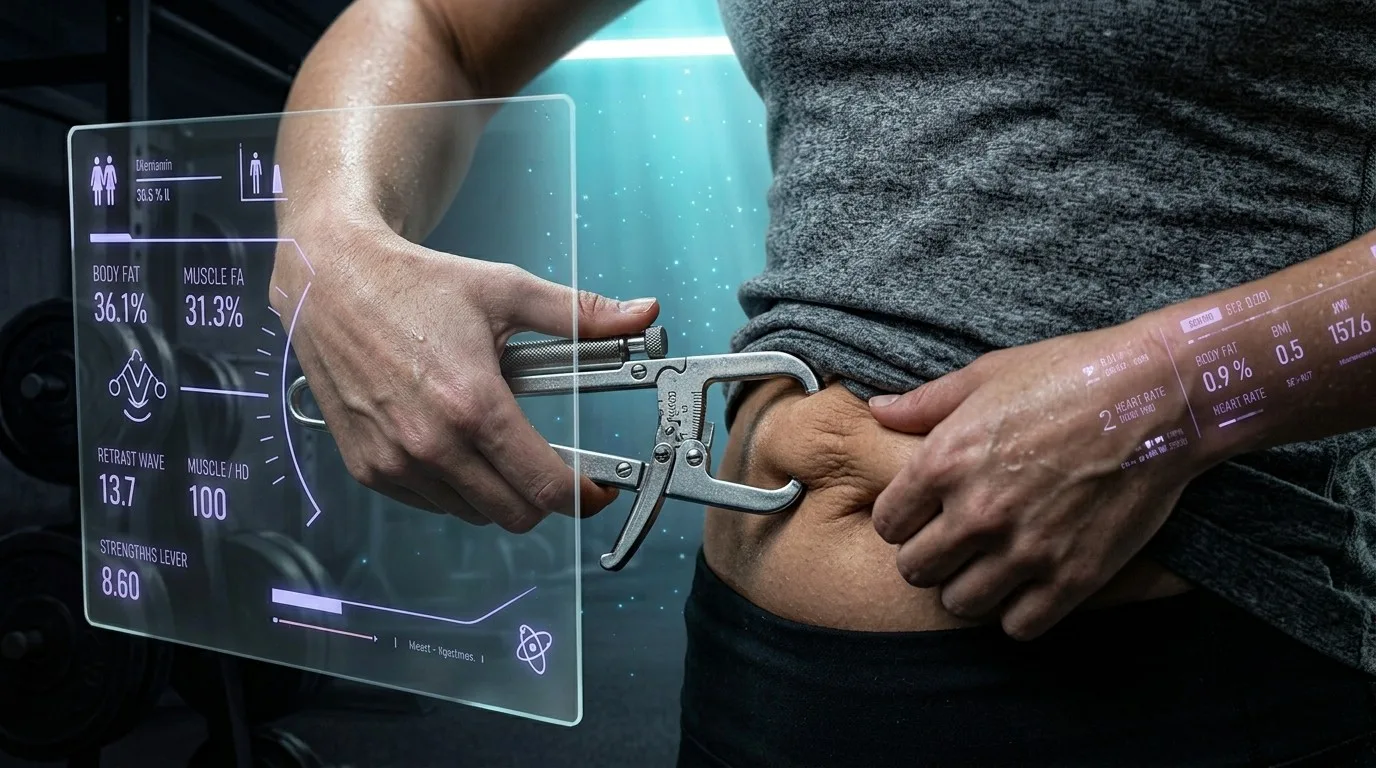
How to measure your body fat with calipers
A scale tells you what you weigh, not what you are made of. Here is how to take skinfold measurements that are actually worth tracking — and how to read the number you get.
 By Jott MythCertified fitness instructor and gamer
Key Takeaways
- Calipers measure skinfold thickness; an equation converts the total into a body fat percentage, accurate to within about 3–4% of a DEXA scan.
- Use the Jackson–Pollock 3-site method if you measure yourself, and never switch methods mid-way.
- Measure on dry skin before training, read the dial two seconds after release, and average two or three readings per site.
- Re-test every four to six weeks — body fat changes too slowly for weekly testing to mean anything.
- Multiply weight by body fat percentage to split it into fat mass and lean mass, which explains a flat scale.
You lost two kilos this month. Was it fat, muscle, or the large glass of water you had not drunk yet? The scale cannot tell you, and that is the whole problem with using it as your only measure of progress.
A set of skinfold calipers costs less than a month of most gym memberships and answers the question the scale cannot: how much of you is fat, and how much is everything else. Here is how to use one properly.
What a caliper actually measures
A caliper pinches a fold of skin and the fat directly beneath it, and measures its thickness in millimetres. It does not see the fat around your organs, and it does not weigh anything.
The useful trick is that subcutaneous fat is distributed in a fairly predictable way across a population. Measure a few specific sites, add them up, and a regression equation estimates your overall body density. A second equation — Siri — converts that density into a body fat percentage. From there, simple arithmetic splits your scale weight into fat mass and lean mass.
Pick one method and stay with it
There are three equations in common use. They disagree with each other by a few percent, which does not matter at all — as long as you do not switch between them mid-way and mistake the switch for progress.
| Method | Sites | Best for |
|---|---|---|
| Jackson–Pollock 3-site | Men: chest, abdomen, thigh. Women: triceps, suprailiac, thigh | The default. Fast, well validated, and every site is reachable on yourself |
| Jackson–Pollock 7-site | Chest, midaxillary, triceps, subscapular, abdomen, suprailiac, thigh | Slightly tighter and less sensitive to one bad pinch, but the back sites need a second person |
| Durnin–Womersley 4-site | Biceps, triceps, subscapular, suprailiac | Upper body only. Reads a little higher than Jackson–Pollock |
If you are measuring yourself with no help, start with the 3-site. It is the standard for a reason.
Where to pinch
Site placement is where most bad readings come from. Take every measurement on the right side of the body, and pinch the fold with your fingers about a centimetre away from where the caliper jaws will sit.
- Chest — a diagonal fold. For men, halfway between the armpit crease and the nipple; for women, one third of the way along that line.
- Abdomen — a vertical fold about two centimetres to the right of the navel.
- Thigh — a vertical fold on the front of the thigh, midway between the hip crease and the top of the kneecap.
- Triceps — a vertical fold on the back of the arm, midway between the tip of the shoulder and the elbow, with the arm hanging relaxed.
- Suprailiac — a diagonal fold just above the hip bone, following the natural angle of your waistline.
- Subscapular — a diagonal fold one to two centimetres below the bottom tip of the shoulder blade, angled down and out.
Taking a reading you can trust
- 1Measure on dry skin, before training. Not after a workout, a shower or a sauna — blood flow and skin temperature both shift the reading.
- 2Pinch the fold firmly with your thumb and forefinger and lift it away from the muscle underneath. You want skin and fat, not a handful of quad.
- 3Place the caliper jaws about a centimetre from your fingers, halfway down the fold, and let them close under their own spring pressure.
- 4Read the dial two seconds after releasing. Wait longer and the fold compresses, and the number drifts down.
- 5Take each site two or three times and use the average. If two readings differ by more than 2 mm, take another.
- 6Record the same sites, in the same order, at the same time of day, every time.
The person taking the measurement matters as much as the caliper. If someone else measures you once and you measure yourself the next time, you have not learned anything about your body — only about the two of you.
Reading the result
Once you have a percentage, the more useful numbers come from combining it with your weight. Fat mass is your weight multiplied by your body fat percentage. Lean mass — muscle, bone, organs and water — is whatever is left.
That split is what makes a stalled scale readable. An 80 kg lifter at 20 percent carries 16 kg of fat and 64 kg of lean mass. If eight weeks later they still weigh 80 kg but measure 17 percent, they have lost 2.4 kg of fat and gained the same in lean mass. The scale recorded nothing. The calipers recorded a very good two months.
| Category | Men | Women |
|---|---|---|
| Essential fat | 2–5% | 10–13% |
| Athletic | 6–13% | 14–20% |
| Fitness | 14–17% | 21–24% |
| Average | 18–24% | 25–31% |
| Above average | 25%+ | 32%+ |
These bands describe where a number sits in the general population. They are not a health verdict, and the athletic ranges in particular are not a target most people should chase or hold year round.
How often to measure
Every four to six weeks. Body fat does not move fast enough to reward weekly testing, and measuring more often mostly samples your own technique error. If you want a weekly number to watch, weigh yourself instead and let the calipers tell the longer story.
Doing this in TrainerQ
You do not need to keep the equations anywhere. On the Add Metrics screen, tap Caliper next to Body Fat Percentage, choose your method, and enter your folds — TrainerQ runs Jackson–Pollock or Durnin–Womersley, converts to a percentage, and splits your weight into fat and lean mass. Every site has a tap-to-open note telling you exactly where to pinch.
The result saves alongside your weight and progress photos, so the trend is there the next time you wonder whether a flat scale means a flat month. It usually does not.
Frequently asked questions
How accurate are body fat calipers?
Skinfold calipers are typically within 3 to 4 percent of a DEXA scan. They are reliable for tracking a trend over months when the same person measures the same sites with the same method, but not precise enough to trust a single reading to the decimal place.
Which caliper method should I use?
Use the Jackson–Pollock 3-site method if you are measuring yourself: chest, abdomen and thigh for men, or triceps, suprailiac and thigh for women. The 7-site method is slightly more robust but needs a second person for the back sites.
How often should I measure body fat with calipers?
Every four to six weeks. Body fat does not change fast enough for weekly measurements to show real change; more frequent testing mostly measures your own technique error.
Can I measure my own body fat with calipers?
Yes. The Jackson–Pollock 3-site method uses sites you can reach yourself. Measure on the right side of the body, on dry skin before training, and take two or three readings per site.
What is a healthy body fat percentage?
For general fitness, roughly 14–17% for men and 21–24% for women. Athletic ranges are 6–13% for men and 14–20% for women, while essential fat is 2–5% for men and 10–13% for women.
About the author
Certified fitness instructor and gamer
I'm a certified fitness instructor who's spent more hours levelling characters than I'd like to admit. I design things, I have 3 cats, and I believe small, steady steps carry you further than any grand leap.
More from Jott Myth →Track It. Don't Guess It.
TrainerQ turns your measurements into a progress trend you can actually read — and your training into something you look forward to.
Start Free